Growth Systems
Growth Systems vs Random Tools: Building Predictable Demand
Why stacking marketing tools stalls growth, and how a connected system of website, automation, AI and ads creates predictable demand.
In this article
When growth stalls, ambitious companies often buy another tool: a new CRM, a new ad platform, a new chatbot. The missing piece is usually infrastructure, one connected system that captures, qualifies and converts demand. Tools are ingredients. A system is the recipe.
Symptoms of a tool stack without a system
- Leads sit unread while ads keep spending.
- Website, CRM and calendar disagree on what a lead is.
- Nobody can explain the path from click to booked conversation.
- Reports show activity but not revenue.
- Each new tool needs someone to copy data into it by hand.
The four parts of a growth system
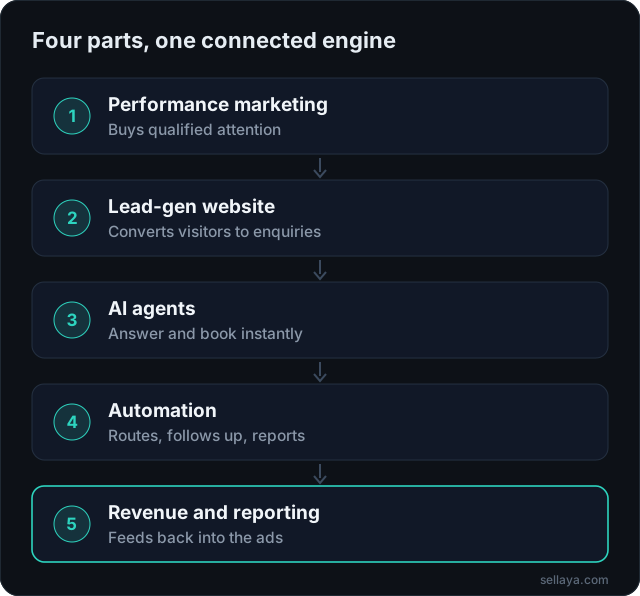
| Part | Job | Fails without it when |
|---|---|---|
| Website | Turns visitors into enquiries | Ads send traffic to a page that cannot convert |
| Automation | Routes, alerts and follows up | Leads wait for a human to notice |
| AI agents | Answers instantly and books | Calls and chats go unanswered after hours |
| Performance marketing | Buys qualified attention | There is no reliable demand to fill the system |
Build in the right order
- Fix the conversion path first: a clear offer, a fast site and a form that works.
- Add instant alerts and follow-up so no lead is left waiting.
- Add tracking so you know which sources produce customers.
- Add coverage for calls and chats outside office hours.
- Only then increase paid spend, because the system can now handle it.
What a connected system looks like day to day
A visitor lands from an ad, reads a page that matches the promise, books a call or submits a form. The lead is recorded with its source, your team is alerted instantly, the visitor gets a confirmation, and a missed call triggers an automatic text. Each step hands off to the next with no one copying data, and each result flows back into reporting.
The Sellaya Digital approach
We design lead-generation websites, automation, AI call agents and performance marketing as one engine, so attention turns into qualified customers. Review real outcomes on our case studies, then book a strategy call to map where your own gaps are.
A 90-day roadmap for building the system
Days 1–30: fix the foundation
Audit the path from first click to booked call. Clarify the offer, tighten the website’s main page and form, and set up conversion tracking and instant alerts. The aim is a single path with no obvious leaks.
Days 31–60: add speed and coverage
Add automated confirmations and follow-up, and cover missed calls and after-hours enquiries, for example with missed call text back or an AI receptionist. Start recording outcomes for every lead.
Days 61–90: scale what works
With tracking and follow-up in place, increase ad spend on the channels that produce customers, test new offers and refine the website using real data. Review cost per customer and show-up rate monthly.
What a connected system changes in practice
| Before | After |
|---|---|
| Leads reach a shared inbox and wait | Instant alert to a named owner |
| Calls go to voicemail out of hours | Calls answered or texted back in seconds |
| Ads judged by clicks | Ads judged by cost per customer |
| Reporting assembled by hand each month | One view from spend to booked calls |
Who benefits most
Growth systems pay off most for businesses where one extra customer is worth a meaningful amount and enquiries arrive through several channels: home services, health and beauty, professional services, real estate and similar local or high-consideration businesses. If you already generate steady referrals and have a simple process, a lighter touch may be enough.
Questions to ask before you buy any tool or service
- What exact step in our path from click to customer does this improve?
- How will we measure that it worked?
- What does it connect to, and who maintains the connection?
- What happens if we cancel in six months: do we keep our data and setup?
Ready to replace noise with a system that moves the business forward?
Book a strategy callFrequently asked questions
What is a growth system?
A growth system is a connected set of website, follow-up, automation and acquisition that takes a stranger to a booked conversation with minimal manual effort, and reports on each step.
Do I need to replace my current tools?
Usually not. The first step is connecting what you already use and removing manual hand-offs. Tools are replaced only when they block the flow.
Where should a small business start?
With the leak that costs the most: often slow follow-up or a website without a clear call to action. Our speed-to-lead article is a good first read.
How do I know the system is working?
Track time to first response, lead-to-booking rate and cost per customer by source. If those improve, the system is working.
Related services
Want this applied to your business?
A 30-minute strategy call. We look at your funnel and show you where leads are leaking.
Book a strategy call