Lead Management
Speed to Lead: Why the First Business to Reply Often Wins
What the research says about response time and lead conversion, and a practical plan to answer enquiries in minutes, not days.
In this article
Someone who has just filled in your form is at the peak of their interest. Every hour that passes, that interest cools, and a competitor may reply first. “Speed to lead” is the time between an enquiry arriving and a real person or system responding. It is one of the cheapest things you can improve, because it needs no extra ad spend.
What the research says
A well-known Harvard Business Review study of online sales leads, “The Short Life of Online Sales Leads”, found that companies that tried to contact a lead within an hour were far more likely to qualify it than those that waited longer, and the odds fell further after a day. The study also found that most firms were slow to respond. The exact multiples depend on the sample, so treat them as a clear direction rather than a promise for your business.
Why businesses respond slowly
- Nobody is clearly responsible for new enquiries.
- Alerts go to a shared inbox that nobody watches in real time.
- Staff are busy delivering work for existing customers.
- Weekend and evening enquiries wait until Monday.
- Leads from different channels arrive in different places.
A practical plan to respond in minutes
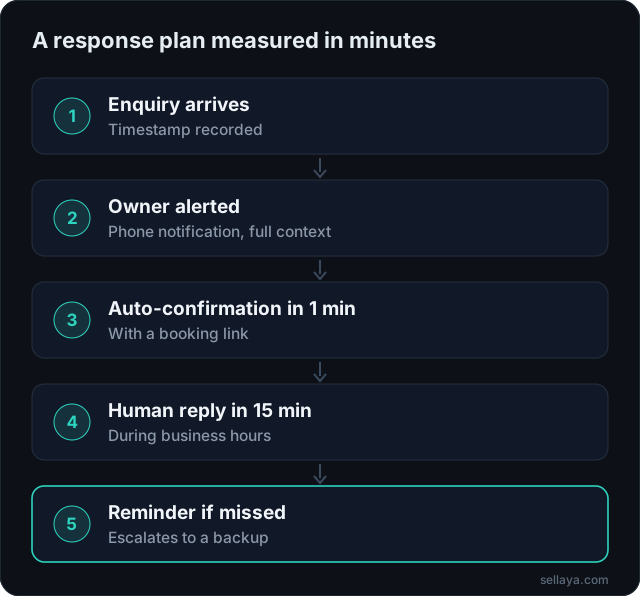
- Name one owner for new leads, with a backup.
- Send an instant alert to their phone with the lead’s name, phone, message and source.
- Send the lead an automatic confirmation within a minute, with a link to book a time.
- Set a target, such as a human reply within 15 minutes during business hours.
- Cover after-hours with an automatic message, or an AI call and chat agent that books appointments.
- Trigger a reminder to the owner if a lead has not been contacted within the target.
What a good first response looks like
Keep it short, human and useful. Thank them by name, repeat what they asked about, say what happens next and offer two easy options: a booking link or a reply. Avoid generic auto-responses that read like a ticketing system.
| Channel | Practical target |
|---|---|
| Website form | Automatic confirmation in under 1 minute, human follow-up within 15 minutes in hours |
| Phone call | Answered live or an immediate text-back |
| WhatsApp or chat | Reply in minutes during business hours |
| Out of hours | Instant automatic message; human reply first thing next morning |
Measure it
Record the time of each enquiry and the time of the first response, then review the average and the slowest ten percent weekly. The slow tail is where jobs are lost. The system behind this is covered in marketing automation that doesn’t drop leads, and the simplest phone version is missed call text back.
Example first-reply messages you can adapt
For a form enquiry
“Hi Sam, thanks for getting in touch about kitchen renovations. I’ve got your details and will call you shortly. If it’s easier, you can pick a time here: [link].” It is short, personal and gives two ways forward.
For an after-hours enquiry
“Hi Sam, thanks for your message. We’re closed until 8am, and one of us will reply first thing. If you’d like to lock in a time now, you can book here: [link].” An honest timeframe beats silence.
Phone, text or email first?
Match the channel the person used when they contacted you, and consider calling first for urgent services. Many people now prefer a text or WhatsApp reply to a voicemail. If you try to reach someone by phone and miss them, follow up straight away with a text so they have something to respond to.
The cost of being slow, in practical terms
A slow response costs more than the one lost lead. It wastes the ad spend that produced the enquiry, damages the impression a buyer forms of how you work, and trains your team to treat leads as low priority. Every channel you pay for makes the cost of delay higher.
Building a response habit in a small team
- Agree a simple response target and write it where the team can see it.
- Assign an owner for each time block, including a backup.
- Review the slowest replies each week and fix the cause, not the person.
- Celebrate fast replies that led to booked jobs.
To build the plumbing behind this, read marketing automation that doesn’t drop leads, and for calls you cannot pick up, see AI call agents for lead qualification.
Want every enquiry answered within minutes, even when you are busy?
Book a strategy callFrequently asked questions
What is speed to lead?
It is the time between a prospect enquiring and your first meaningful response. Shorter times are strongly associated with better chances of starting a conversation and winning the job.
Is an automatic reply enough?
It helps by confirming receipt and offering a booking link, but it should be followed by a human or a capable agent quickly. It keeps interest alive, it does not replace a real conversation.
What if I cannot reply during the day?
Use automation for confirmation and booking, and an AI receptionist or answering service for calls. Then check enquiries at fixed times, for example every hour.
Does faster response matter for high-ticket services?
Yes, although the sales cycle is longer. A fast, helpful first reply still shapes the buyer’s impression of how you will work with them.
Sources
Related services
Want this applied to your business?
A 30-minute strategy call. We look at your funnel and show you where leads are leaking.
Book a strategy call