Automation
Marketing Automation That Doesn’t Drop Leads
How to design lead routing, instant alerts and follow-up automation so inbound enquiries never die in a spreadsheet or shared inbox.
In this article
Automation fails when it is a pile of tools instead of a system. The goal is simple: every lead is captured, assigned, confirmed and followed up without anyone babysitting it. Below is the structure we use when we build automation systems for service businesses.
Where leads actually get lost
Leads rarely fail at the form. They fail in the gaps afterwards: an email lands in an inbox nobody checks, a WhatsApp message sits unread overnight, a calendar booking never reaches the CRM. Map your own path from first click to booked call and mark every hand-off. Each hand-off is a place a lead can disappear.
Capture once, sync everywhere
Forms, chat and calendar bookings should write to one source of truth. Duplicate records and “who owns this?” debates cost deals. Decide what counts as a lead, what the required fields are, and which system is the master record.
Notify a human immediately
- Alert the right person the moment a high-intent form lands, by email, SMS or chat.
- Include context in the alert: service interest, message, source page and phone.
- Send the lead a confirmation with a booking link, so they can act while interest is high.
- Escalate if nobody has responded within a set time.
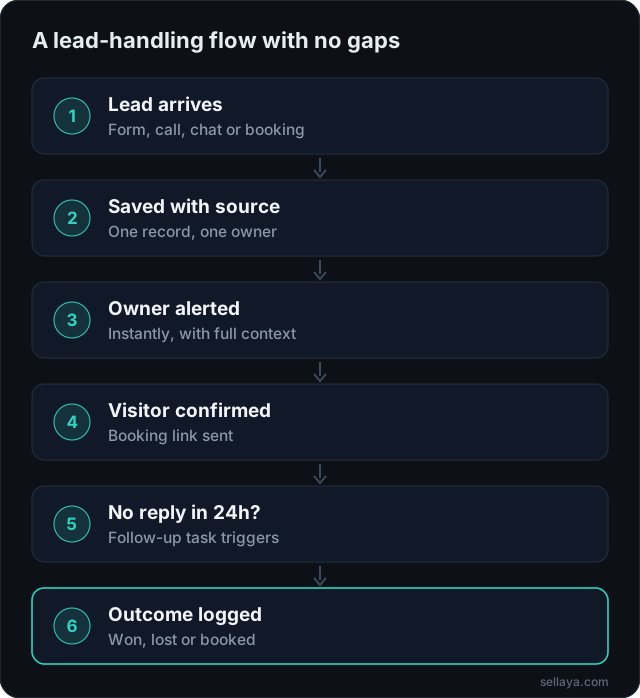
A simple lead-handling flow
- Visitor submits a form or books a call.
- Lead is saved to the CRM or sheet with source and timestamp.
- Owner is alerted instantly with the full context.
- Visitor receives a confirmation and a booking link.
- If there is no reply or booking within a day, a follow-up task or message is triggered.
- Outcome (booked, lost, won) is recorded so you can see which sources pay off.
Design for exceptions, not only the happy path
Weekend enquiries, incomplete phone numbers, international customers and multi-location businesses all need rules. Decide who covers after hours, what happens when a field is missing, and how spam is filtered. A honeypot field and basic rate limiting stop most junk without annoying real people.
What not to automate
Automate the repetitive hand-offs, reminders and data entry. Keep humans on pricing conversations, sensitive situations and anything where tone matters. Over-automated follow-up that feels robotic costs more trust than it saves time. When the first response needs to be instant and personal, pair automation with a voice or chat agent and a clean hand-off to a person.
Measure it
| Metric | What it tells you |
|---|---|
| Time to first response | Whether alerts and ownership work |
| Lead to booked-call rate | Quality of site, offer and follow-up |
| Leads with no owner after 24h | Leaks in routing |
| Source to revenue | Which channels deserve more budget |
Speed matters most of these. See why speed-to-lead decides who wins the job for the research behind it.
Choosing tools without overcomplicating it
The best automation is usually the simplest one that your team will actually keep using. A spreadsheet plus instant alerts can beat a complex CRM that nobody updates. Choose tools in this order: first decide the process, then pick the lightest tool that supports it, then connect it to the rest.
| Your situation | Start with |
|---|---|
| One person handles all enquiries, under ~30 a month | Form to spreadsheet, plus email or SMS alerts |
| Two to five people share leads | A simple CRM with owner assignment and reminders |
| Many sources (ads, calls, chat, referrals) | A CRM with source tracking and automated routing |
| Calls matter most | Add an AI call agent or missed-call text-back |
Follow-up sequences that feel human
A good sequence is short and respectful. One confirmation straight away, one helpful message the next day if nobody has booked, and a final polite check-in a few days later. Each message should add something, such as an answer to a common question or a clear link to book, rather than repeat “just checking in”.
- Use the person’s name and mention what they asked about.
- Keep each message to a few sentences and one clear action.
- Stop the sequence the moment the person replies or books.
- Always include a simple way to opt out of marketing messages.
Data hygiene: the unglamorous part that makes it work
Automation multiplies whatever data you give it. Normalize phone formats, prevent duplicate records, and record the source of every lead. A weekly five-minute check for leads without an owner or a next step catches problems before they cost you jobs.
Security and privacy basics
Lead data is personal data. Limit who can access it, use strong passwords and two-factor authentication on every tool, and publish a clear privacy policy that says what you collect and why. If you operate in Canada, confirm your obligations under privacy and anti-spam law with a professional.
Once the basics run reliably, the natural next steps are faster response (speed to lead) and covering calls you cannot answer (missed call text back).
We build automation infrastructure that keeps demand moving.
See automation systemsFrequently asked questions
What is lead routing automation?
It is a set of rules that decides who receives each new lead and how they are told, based on factors like service, location or time of day. It removes the manual step of someone checking an inbox and forwarding messages.
Do I need a CRM to automate lead follow-up?
Not to start. A well-structured spreadsheet with instant alerts can work for low volumes. A CRM becomes worthwhile when several people handle leads or you want reporting on source and outcomes.
Can automation hurt the customer experience?
Yes, if it replaces real conversation where a person is expected. Use it for speed, reminders and organization, and make it easy to reach a human.
How long does it take to set up?
A basic capture, alert and confirmation flow can be live in days. Deeper CRM integrations and multi-step follow-up take longer because they depend on how your team already works.
Related services
Want this applied to your business?
A 30-minute strategy call. We look at your funnel and show you where leads are leaking.
Book a strategy call