Websites
Lead Generation Website vs Brochure Website Explained
A brochure site describes your business; a lead-generation site is built to produce enquiries. Compare the two and see which your business needs.
In this article
Many service businesses have a perfectly nice website that brings in almost no enquiries. It is usually a brochure: it describes who you are, but nothing about it is designed to make a visitor take the next step. A lead-generation website has a different purpose and is built differently, even if the two look similar at a glance.
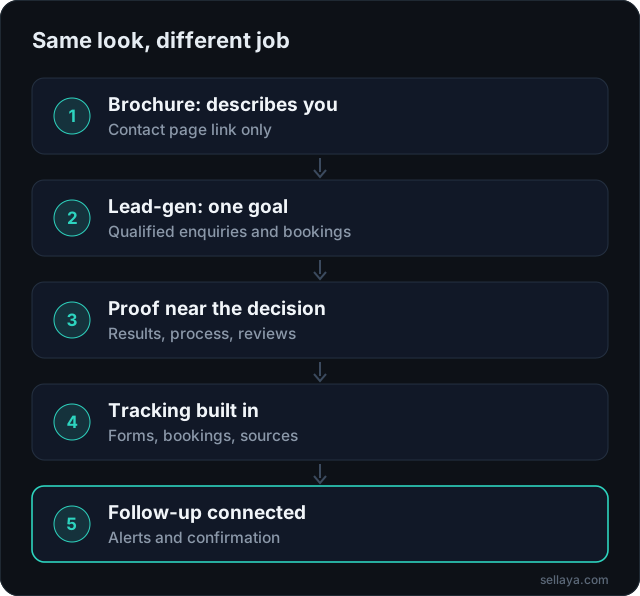
Side-by-side comparison
| Brochure website | Lead-generation website | |
|---|---|---|
| Main goal | Look professional | Produce qualified enquiries and bookings |
| Homepage message | About us and what we do | Who we help, the outcome and the next step |
| Calls to action | A contact page link | Repeated, specific actions on every page |
| Proof | Logos and generic text | Specific results, process and reviews placed near the decision |
| Tracking | Page views | Form submits, bookings, calls and sources |
| Follow-up | Email to a shared inbox | Instant alerts, confirmation and booking |
| Search | One page for everything | A page per service and location, with FAQs |
Signs you have a brochure website
- Your homepage leads with your history or team photo.
- The only way to act is a generic “Contact” page.
- You do not know how many enquiries it produces, or from where.
- It loads slowly on a phone or the layout breaks on small screens.
- All your services sit on one page, so Google has no specific page to show for each.
What changes in a lead-generation build
Message and structure
Each page has a single job, a clear headline for a defined audience and one primary call to action. Service pages answer the questions a buyer has before they call: what is included, how it works, what it costs in broad terms and what happens next.
Technical foundations
Fast loading on mobile, clean page titles and descriptions, structured data so search engines understand your business, and a sitemap so every page can be indexed. These are what let you appear in Google for the searches your customers make.
Connected follow-up
A form that alerts the right person instantly and sends a confirmation with a booking link. Without this, even a perfect page leaks leads. See marketing automation that doesn’t drop leads.
When a brochure site is enough
If your work comes entirely from referrals and you only need a credible place to send people, a simple brochure site is fine. It stops being enough when you want to grow through search, ads or social, because then the site needs to convert strangers.
How to decide
- Check how many enquiries your site produced last month, and from which source.
- Ask three recent customers what they looked at before contacting you.
- Test the site on your phone, on mobile data, and time how long it takes to find a way to contact you.
- If the answers are weak, plan a conversion-focused rebuild or fix the biggest leaks first.
What it costs and what you get
A simple brochure site is cheaper to build but often costs more in lost enquiries. A lead-generation site takes more planning, because messaging, structure, tracking and follow-up all need design, but each extra enquiry it produces is worth real money. Judge cost against what one new customer is worth to you, not against a template price.
Content a lead-generation site needs
- A homepage that states who you help and the outcome, with one clear next step.
- A page for each service, with benefits, process, pricing guidance and an FAQ.
- Location pages if you serve distinct areas, written for real local detail rather than copied text.
- A proof page or section with specific results and named reviews.
- Privacy policy and terms, and clear contact details.
Technical checklist
| Item | Why it matters |
|---|---|
| Mobile layout and speed | Most visitors arrive on phones |
| Unique titles and descriptions | Helps search results make sense |
| Structured data | Lets search engines understand your business |
| Sitemap and robots file | Helps every page get found and indexed |
| Analytics and conversion events | Shows what actually produces enquiries |
A realistic timeline
A focused service-business website typically needs time for planning the message, writing, design, build, testing and tracking setup. Delays usually come from waiting on content and approvals, so gather photos, reviews and service details early. After launch, plan a review a month in, because real visitor behavior always teaches you something new.
Once the site converts, connect it to follow-up with automation and keep improving with the lead generation website checklist.
Want a website that works as a sales channel, not just a business card?
Explore lead-gen websitesFrequently asked questions
What is a lead generation website?
It is a website designed around one outcome: getting qualified visitors to enquire or book. It combines clear messaging, proof, simple forms, tracking and follow-up.
Can I turn my existing site into a lead-generation site?
Often, yes. Improving the headline, call to action, form, speed and tracking can change results without a full redesign. If the platform is slow or inflexible, a rebuild may be better.
Will a lead generation website help me rank on Google?
Good structure helps: fast pages, one page per service, clear titles and structured data. Rankings also depend on competition, content and links, so no website can promise a position.
How long does a rebuild take?
It depends on the number of pages and integrations. A focused site is typically a matter of weeks rather than months. We scope it on a call.
Related services
Want this applied to your business?
A 30-minute strategy call. We look at your funnel and show you where leads are leaking.
Book a strategy call