Performance Marketing
Google Ads vs Meta Ads for Lead Generation: Which Fits?
Search intent versus social discovery: how Google Ads and Meta Ads differ for lead generation, and how to choose or combine them.
In this article
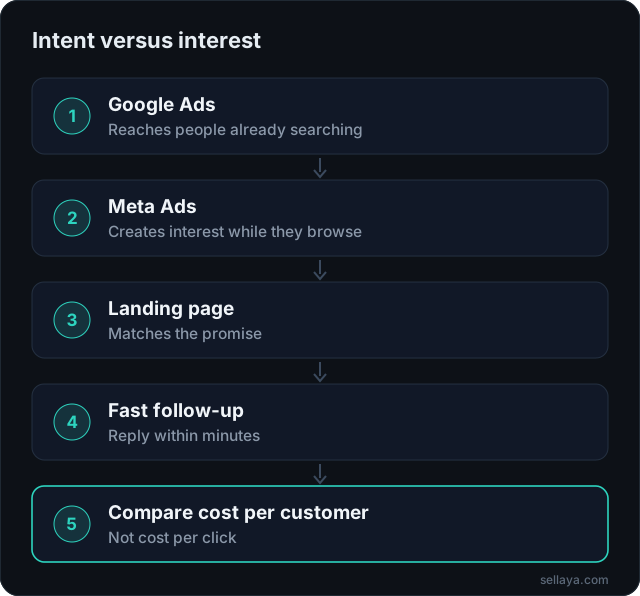
Both Google Ads and Meta Ads (Facebook and Instagram) can generate leads, but they work in opposite ways. Google reaches people who are already searching for what you sell. Meta reaches people while they browse and gives you the chance to create interest. Choosing well saves budget and avoids the most common disappointment: lots of leads that never answer the phone.
The core difference: intent versus interest
Someone searching “emergency plumber near me” has a problem now. Someone scrolling Instagram who sees a bridal makeup ad may like the idea, but is not necessarily ready to book. Search captures existing demand. Social creates and nurtures it. Neither is better in general; each is better for a particular situation.
| Google Ads (Search) | Meta Ads | |
|---|---|---|
| Audience mindset | Actively looking | Browsing, open to discovery |
| Best for | Urgent or high-intent services | Visual, considered or local-awareness offers |
| Creative | Text-led, keyword-driven | Image and video-led |
| Lead quality pattern | Usually closer to buying | Often needs faster, warmer follow-up |
| Scales by | Search volume in your area | Audience size and creative variety |
| Needs | Strong landing page for each service | Strong creative and a simple lead path |
When Google Ads is usually the better first step
- People search for your service when they need it, such as repairs, legal help or clinics.
- You have a clear service area and good landing pages per service.
- You can answer calls and forms quickly.
When Meta Ads is usually the better first step
- The offer is visual, such as beauty, interiors, events or food.
- Few people search for it by name, but many would like it once they see it.
- You have strong photos, video or before-and-after content.
- You want to retarget visitors who did not book the first time.
Using both together
Many businesses start with one channel, prove it works, then add the other. Meta can warm audiences and retarget website visitors, while Google captures the searches that follow. Keep tracking separate for each campaign so you can see which produce customers.
What matters more than the channel
- A landing page that matches the ad promise. See our lead generation website checklist.
- Conversion tracking set up correctly in both platforms.
- A reply within minutes. Read speed to lead.
- A clear, specific offer instead of a generic brand message.
If these are weak, neither platform will rescue the result. If they are strong, almost any sensible channel can work. Our performance marketing work starts there, before spend is scaled.
Budget and expectations for a local service business
There is no universal minimum, but a very small budget spread across many campaigns rarely produces enough data to learn from. It is usually better to focus on one channel, one or two services and one geographic area, then expand once you see real results. Search costs depend heavily on how competitive your keywords are, and social costs depend on audience and creative quality.
Targeting basics for each platform
Google Ads
- Group keywords by service, such as “emergency plumber” or “bridal makeup”, and write ads that match each.
- Add negative keywords to block irrelevant searches like jobs, free or DIY.
- Target the area you actually serve, and check the actual searches regularly.
Meta Ads
- Start with location, age range and broad interests, then let the platform find responders.
- Use strong visuals and a clear offer in the first line of text.
- Retarget website visitors and people who engaged with your page.
Landing pages: where ad money is won or lost
Whichever platform you choose, send traffic to a page built for that offer rather than the homepage. Match the headline to the ad, show proof, keep the form short and make the next step obvious. A visitor who has just clicked an ad is deciding in seconds.
Common mistakes
- Running both platforms with a tiny budget each and learning nothing from either.
- Optimizing for form fills without checking whether they become customers.
- Ignoring mobile, where most social clicks arrive.
- Letting leads wait: see speed to lead.
For measurement that goes beyond clicks, read performance marketing without vanity metrics.
Not sure which channel to start with? We will review your offer and recommend one.
Book a strategy callFrequently asked questions
Is Google Ads or Facebook Ads better for lead generation?
It depends on how people find your service. Google tends to work well when people actively search for it. Meta tends to work well for visual offers where you build interest. Many businesses use both over time.
How much should I spend to test?
Enough to collect meaningful data over several weeks. Your location, competition and keywords change the minimum, so base it on how many leads you need to judge results rather than on a fixed number.
Why are my Meta leads low quality?
Common causes include a vague offer, instant-form leads with minimal effort, and slow follow-up. Adding a qualifying question or sending traffic to a landing page often improves quality.
Do I need a website to run these ads?
A focused landing page nearly always outperforms sending traffic to a general homepage. It also lets you track conversions properly.
Related services
Want this applied to your business?
A 30-minute strategy call. We look at your funnel and show you where leads are leaking.
Book a strategy call