Performance Marketing
Performance Marketing Without Vanity Metrics
How to run paid campaigns that optimize for qualified leads and booked calls instead of clicks, impressions and empty traffic.
In this article
Paid media fails when the website and follow-up cannot convert what it buys. Good performance marketing buys attention your system can turn into qualified customers, and it is judged by pipeline and revenue, not by how many people saw an ad.
What counts as a vanity metric
Impressions, reach, clicks and even raw lead counts can all look healthy while the business gets nothing. They are inputs. A campaign can drive thousands of cheap clicks from people who never intended to buy, or fill a form with junk because the offer was vague.
| Looks good | Better question |
|---|---|
| Impressions and reach | How many qualified enquiries did this produce? |
| Click-through rate | What share of clicks became booked calls? |
| Cost per click | What is our cost per qualified lead and per customer? |
| Total leads | How many leads did we actually answer in under an hour? |
Define the conversion that matters
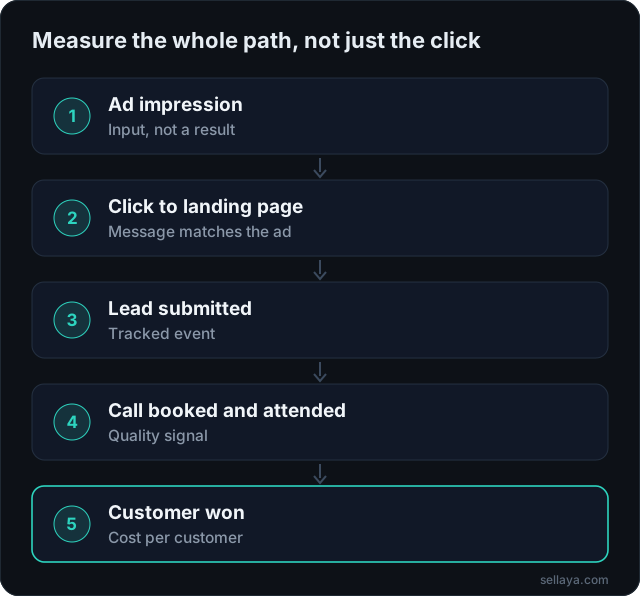
Optimize toward booked calls or sales-qualified leads, not soft actions like page likes or low-intent form fills. Match the ad promise, the landing page offer and the post-submit experience. If an ad promises a free consultation, the page should lead straight to a booking, not a generic homepage.
Close the measurement loop
- Track lead submit, calendar open and booked-call events in analytics and in each ad platform.
- Pass quality signals back to campaigns, such as service type, location and whether the lead showed up.
- Use unique tracking per campaign so you can compare sources honestly.
- Fix landing-page and follow-up problems before you scale spend.
Creative and offer discipline
Test messages that promise a specific next step to a specific audience. Vague brand ads leading to a vague homepage waste spend even when the cost per thousand impressions looks cheap. Change one variable at a time, keep a test log, and let each test run long enough to mean something.
Choosing channels
Search ads capture people who are already looking; social ads create demand and reach people earlier. Which fits depends on your offer and sales cycle. We compare them in Google Ads vs Meta Ads for lead generation.
A simple monthly review
- Cost per qualified lead and cost per booked call by campaign.
- Lead-to-customer rate by source, from your CRM or sheet.
- Which creative and keywords produced the best leads, not just the most.
- What to pause, what to test next, and what is blocking conversion off the ad platform.
Build a measurement stack in four layers
- Ad platform conversion events: lead submitted and booking completed, sent to Google and Meta.
- Website analytics: sessions, sources and events in GA4, with form and calendar actions named clearly.
- A lead log or CRM: source, service, owner and outcome for every enquiry.
- A monthly summary that joins spend to customers, so you see cost per customer by campaign.
Most small businesses do the first layer, skip the third, and wonder why reports disagree. The log is what lets you prove which campaigns produce paying customers.
Budgeting and testing without wasting money
Start with a budget you can afford to lose while you learn, and decide in advance what you are testing: an offer, an audience, a creative angle or a landing page. Give each test enough time and traffic to show a pattern, and resist changing everything when results wobble for a few days.
- Test one variable at a time and write down the hypothesis.
- Keep a simple test log: what changed, when, and what happened.
- Cut clear losers quickly, but let promising tests mature before judging them.
- Reinvest in what produces customers, not what produces the cheapest clicks.
Attribution is messy, so keep it simple
People rarely convert on the first visit. They might see an ad, search your name later and book through a link. Perfect attribution is not possible, so use a few practical rules: track the original source, ask “how did you hear about us?” on the form or call, and look at trends over weeks rather than single days.
Red flags in an agency report
- The report leads with impressions, reach and clicks and never mentions customers.
- There is no connection between ad spend and booked calls or revenue.
- Results are compared with generic industry averages instead of your own baseline.
- You cannot see inside the ad accounts.
If you are weighing platforms, read Google Ads vs Meta Ads for lead generation. If leads are already coming in but not closing, start with speed to lead before you add budget.
We engineer acquisition that your growth system can actually convert.
Performance marketingFrequently asked questions
What is performance marketing?
It is paid advertising managed against measurable outcomes such as leads, bookings or sales, rather than awareness alone. You pay based on, and are judged by, results you can track.
What is a good cost per lead?
It depends heavily on your industry, location and what a customer is worth. Compare cost per qualified lead to the lifetime value of a customer rather than to other businesses’ numbers.
How long before paid campaigns start working?
Platforms need some data to optimize, and early weeks are usually for testing offers, audiences and creative. Expect to refine continuously rather than get a perfect result from day one.
Should I fix my website before running ads?
If it has no clear call to action, tracking or follow-up, yes. Otherwise you pay for traffic that cannot convert. See the lead generation website checklist.
Related services
Want this applied to your business?
A 30-minute strategy call. We look at your funnel and show you where leads are leaking.
Book a strategy call